Illusion and Integrity: Ancient Philosophy and the Examined Life

Summary: “Illusion and Integrity: Ancient Philosophy and the Examined Life” argues that ancient philosophy remains essential for navigating today’s chaotic, media-saturated, and morally fragmented world. Drawing on Socrates, Plato, Aristotle, and Epicurus, the essay emphasizes the urgency of cultivating self-reflection, critical thinking, and ethical clarity amid constant distraction, misinformation, and social pressure. Together, these philosophies serve as intellectual tools for preserving integrity, discernment, and human dignity in an unstable and uncertain world.
The study of Socrates, Plato, Aristotle, and Epicurus has provided a comprehensive framework for understanding enduring questions of ethics, justice, knowledge, and human flourishing. Although these philosophers differ in method and emphasis, they share a commitment to guiding individuals toward a life grounded in reason, integrity, and self-awareness. Their ideas remain deeply relevant to our present social, political, and ethical predicament, particularly in a world where truth is often obscured by illusion, desire, and immediate gratification.
Socrates is remembered not only as a philosopher but as a relentless questioner who challenged individuals across all levels of Athenian society. He refused to accept unexamined beliefs, whether they came from politicians, poets, or ordinary citizens. In defending himself before the Athenian court, Socrates did not attempt to appease his accusers or abandon his principles to preserve his life. Instead, he defended his method of questioning as a moral duty, claiming that the gods had sent him to awaken others toward a more virtuous path (Plato, Apology 29d–30b). His famous assertion that “the unexamined life is not worth living” captures the core of his ethical philosophy: a meaningful life requires humility, critical reflection, and the courage to question what merely appears to be true (Plato, Apology 38a).
Central to Socratic and Platonic thought is the recognition that appearances are deceptive. What we see is not always the truth, and individuals are often misled by illusions that prevent genuine understanding. Plato articulates this idea through different levels of reality—shadows, images, physical objects, and the intelligible realm. Sense perception alone cannot provide true knowledge; instead, it can trap individuals in an imaginary state of mind (Republic 509d–511e). True knowledge belongs to the intelligible realm and is grasped by reason. Through education, critical thinking, and disciplines such as mathematics, the soul ascends toward higher understanding, ultimately grasping the Form of the Good. Just as the sun enables vision by illuminating the physical world, the Form of the Good enlightens the soul and makes truth and moral clarity possible (Republic 508a–509c).
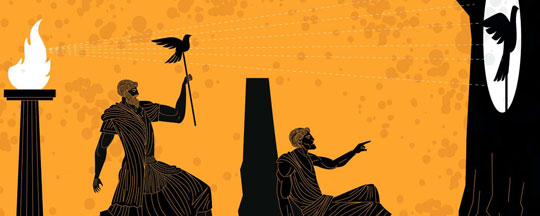 Plato develops this insight most vividly in the Allegory of the Cave. In this allegory, most people live in ignorance, mistaking shadows for reality. The prisoners, chained in darkness, represent individuals who uncritically accept beliefs shaped by social convention and authority (Republic 514a–515c). Education, for Plato, is the process of freeing the mind from these chains and guiding it toward the light of truth. If the prisoners were released and allowed to leave the cave, they would encounter an entirely different world—symbolizing the difficult but transformative journey from ignorance to enlightenment (Republic 516a–517c). This allegory resonates strongly today, particularly in an era dominated by misinformation, media saturation, and ideological polarization.
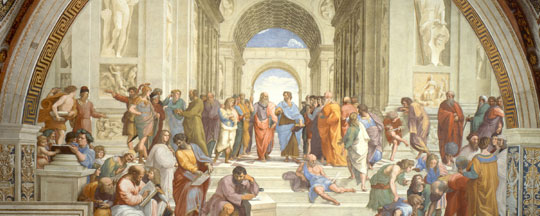 The philosophical contrast between illusion and truth is also captured visually in Raphael’s School of Athens. In this painting, the gestures of Plato and Aristotle serve as profound representations of their philosophical differences. Plato is depicted pointing upward, symbolizing his belief in a higher, eternal realm of perfect Forms beyond the physical world. Aristotle, with his hand directed downward, represents his commitment to empirical observation and the study of the natural world as the foundation of knowledge. Although Aristotle was trained in Plato’s Academy and initially embraced the theory of Forms, he redirected his inquiry toward understanding concrete, dynamic processes. His work extended across logic, metaphysics, ethics, biology, and psychology, reflecting an effort to uncover the principles governing both nature and human behavior.
Plato maintained that society could flourish only when guided by knowledge rather than opinion, truth rather than illusion, and reason rather than desire (Republic 473c–474b). Aristotle, by contrast, systematized logic as the foundation of scientific reasoning. His formulation of the syllogism—such as “All humans are mortal; Socrates is human; therefore, Socrates is mortal”—became a cornerstone of deductive logic and reinforced the role of rational inquiry in uncovering truth (Velasquez 89). Through Raphael’s artistic interpretation, the upward and downward gestures of Plato and Aristotle encapsulate two enduring visions of philosophy: one oriented toward transcendent ideals, and the other grounded in lived human experience. Plato further deepens the ethical and political dimensions of ancient philosophy in Crito, where Socrates refuses Crito’s offer to help him escape from prison. Despite believing that his conviction was unjust, Socrates insists on respecting the laws of Athens. He argues that escaping would violate the social contract he had implicitly accepted by choosing to live under Athenian law (Plato, Crito 50a–51c). Plato presents justice as dependent on a harmonious relationship between the individual and the state, grounded in consent, reason, and duty. This dialogue continues to raise difficult questions about civil disobedience, political obligation, and the limits of moral responsibility in the face of injustice.
While Socrates, Plato, and Aristotle focus heavily on truth, justice, and reason, Epicurus offers a distinct yet complementary ethical perspective centered on pleasure and human well-being. In contemporary society, pleasure is often understood as stimulation, indulgence, and consumption. Popular culture frequently equates pleasure with luxury, excess, and immediate gratification. Epicurus, however, articulated a radically different and more philosophical account of pleasure. For the Epicureans, pleasure is not the pursuit of excess but the absence of bodily pain and freedom from mental disturbance (Epicurus, Letter to Menoeceus). Epicurus distinguishes between natural and necessary desires—such as those required for health, tranquility, and basic happiness—and empty or vain desires, which arise from social pressures, status seeking, and misguided beliefs about success (Letter to Menoeceus). While modern culture encourages the endless expansion of desire, Epicurus insists that genuine happiness comes from recognizing limits and freeing oneself from unnecessary wants. The goal of life is balance: bodily well-being combined with mental liberation, achieved through rational judgment.
Indeed, Epicurus elevates prudence as the greatest good, even above philosophy, because it enables individuals to discern which desires lead to true happiness and which generate anxiety and suffering (Letter to Menoeceus). Prudent individuals do not surrender their lives to fate, necessity, or the illusions of fortune. Instead, they recognize the role of chance while affirming human agency and rational choice. Through prudence, moderation, and disciplined reflection, Epicurean pleasure becomes not an escape into indulgence but a serious ethical practice aimed at achieving a stable, tranquil, and genuinely fulfilling life.
Conclusion:
Taken together, these ancient philosophies offer powerful guidance for contemporary life. Ethically, Socrates teaches that virtue and truth must take precedence over self-interest. Politically, Plato reminds us that justice depends on harmony between individual conscience and civic duty. Aristotle demonstrates the value of reason, observation, and systematic inquiry, while Epicurus challenges modern assumptions about pleasure and happiness. In a world dominated by appearances, excess, and distraction, these philosophers collectively call us to live examined lives—resisting illusion, moderating desire, and acting with integrity in pursuit of truth and genuine well-being.
Citation:
Epicurus. Letter to Menoeceus. In The Basic Works of Epicurus, translated by Cyril Bailey, Modern Library, 1931.
Plato. Apology. Translated by G. M. A. Grube, revised by John M. Cooper, Hackett Publishing Company, 2002.
Plato. Crito. Translated by G. M. A. Grube, revised by John M. Cooper, Hackett Publishing Company, 2002.
Plato. Republic. Translated by G. M. A. Grube, revised by C. D. C. Reeve, Hackett Publishing Company, 1992.
Velasquez, Manuel, et al. “Aristotle.” Philosophy: A Historical Survey with Essential Readings, 9th ed., Wadsworth Cengage Learning, 2014. PDF.
References:
Hedges, Chris. Empire of Illusion: The End of Literacy and the Triumph of Spectacle. Nation Books, 2008.
Plato. The Apology of Socrates. The Center for Hellenic Studies, translated by Benjamin Jowett; adapted by Miriam Carlisle, Thomas E. Jenkins, Gregory Nagy, and Soo-Young Kim, chs.harvard.edu/primary-source/plato-the-apology-of-socrates-sb/.