The Joke of July 4: Reflections on the 250th Birthday of an Empire
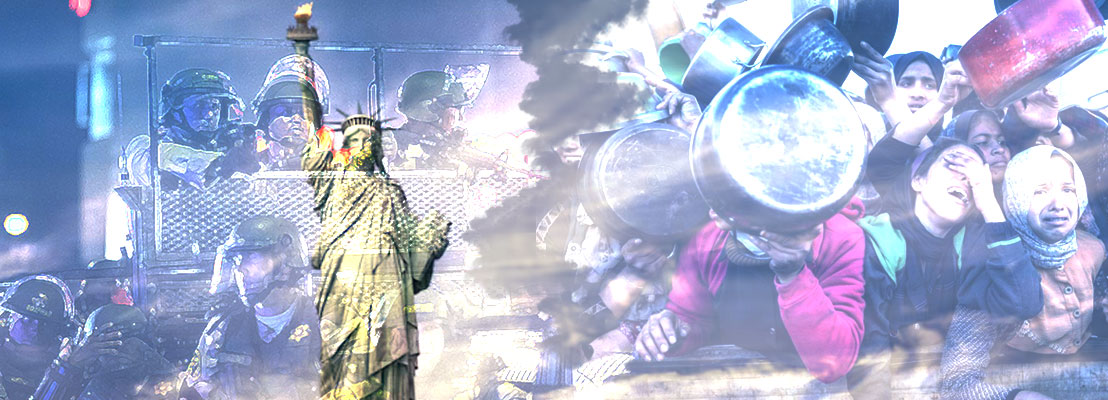
Yep, it is the Fourth of July, 2026—the 250th anniversary of the United States. For millions, it is a day of fireworks, flags, and patriotic celebration. For me, it is something else entirely. It is another ritual of American exceptionalism, another display of jingoism, another annual reminder of the mythology that insists the United States is "the greatest country on Earth."
That mythology grows harder to sustain with each passing year.
One hopeful sign is that more people, both in the United States and around the world, have begun to question the official narrative. More are recognizing the contradictions between the nation's ideals and its actions. Yet I also fear that this awakening has not been enough to halt the destructive consequences of American power across the globe.
We live in an age in which violence has become normalized. Mass death, displacement, starvation, genocide, and war have become daily headlines that many consume before moving on to sports scores, streaming series, celebrity gossip, or the latest social media trend. Our attention is fragmented. Our moral outrage is fleeting. We have become desensitized to suffering on a scale that should horrify us.
What is evil?
It is a question that philosophers have wrestled with for centuries, yet one that contemporary political discourse often avoids. We are comfortable speaking about injustice, human rights violations, oppression, or unethical conduct. We are far less willing to use the language of evil.
As Richard J. Bernstein observes in Radical Evil: A Philosophical Interrogation, philosophers and political theorists are generally much more comfortable discussing injustice or violations of human rights than confronting the concept of evil itself. When theologians discuss evil, they often frame it as the problem of reconciling human suffering with belief in an all-powerful and benevolent God. Even that discussion, Bernstein argues, has become increasingly specialized and disconnected from the lived experiences of ordinary people.
Today, the language of evil seems almost absent from our moral vocabulary.
Looking at the devastation in Gaza and the wider region, I cannot help but ask whether we should be willing to speak in those terms again. In my view, the actions of the Israeli state—including the large-scale killing of civilians, the destruction of communities, and military operations extending into neighboring countries—raise profound moral questions. I also believe the ideology of Zionism, as it has been expressed through policies of occupation, settlement, and unequal ongoing mass killing of Palestinians, and now the killings of Lebanese, deserves serious ethical scrutiny.
Bernstein notes that discussions of evil often return to familiar historical examples: Nazi atrocities, sadistic cruelty, torture, genocide, and the deliberate infliction of suffering upon innocent people. Yet, he argues, these examples are often treated as morally self-evident rather than as opportunities to deepen our understanding of evil itself.
His observation prompts another question: Why does our moral vocabulary seem so hesitant when confronting atrocities unfolding in our own time?
Whether one agrees with the use of the term genocide regarding Gaza or not, the scale of destruction and human suffering has forced millions around the world to reconsider long-held assumptions about Israel, international law, and the role of Western governments in enabling war. For many observers, these events have exposed profound contradictions between the values Western democracies claim to uphold and the policies they support.
The same contradictions exist in the history of the United States.
The celebration of America's 250th anniversary often overlooks the foundations upon which the nation was built: the enslavement of millions of Africans; the violent dispossession and destruction of Indigenous nations; centuries of racial segregation; and repeated military, political, and economic intervention throughout Latin America, the Caribbean, Asia, Africa, and the Middle East.
Indigenous nations such as the Lakota, Cherokee, Cheyenne, Seminole, Crow, and countless others endured forced removal, warfare, broken treaties, and cultural destruction. Their histories are not footnotes—they are central to the American story.
Nor should we forget how economic exploitation has shaped U.S. relations throughout the Western Hemisphere. Policies such as the Monroe Doctrine and the ideology of Manifest Destiny helped justify expansion, intervention, and global domination in the name of national destiny and strategic interests. The consequences of those policies continue to shape international relations today.
The contradictions extend beyond foreign policy.
Within the United States, millions struggle with inadequate access to healthcare, rising housing costs, homelessness, crushing inequality, underfunded schools, addiction, and mass incarceration. Immigration enforcement continues to separate families and generate fear in vulnerable communities. For many Americans, the promise of liberty and justice remains painfully incomplete. I would argue we never truly had it, but a mere illusion.
Against this backdrop, I find little reason to celebrate.
The Fourth of July reminds me not only of America's founding ideals, but also of the distance between those ideals and the realities experienced by many people—both within its borders and beyond them.
Perhaps genuine patriotism is not unquestioning celebration but honest reckoning. Perhaps loving humanity requires us to confront uncomfortable truths about power, empire, and violence rather than hide behind national myths.
On this 250th anniversary, I do not celebrate an empire. I reflect on its legacy, mourn its victims, and hope for a future in which justice is measured not by military strength or global dominance, but by our shared commitment to human dignity.
Happy 250th birthday, America.
Farewell to the illusion of an everlasting empire. As the fireworks fade into the night, so too may the myth of "the greatest country in the world." Every empire believes itself permanent—until history proves otherwise.
May your next chapter begin not with another celebration of power, but with the revolution we so desperately need: one rooted in justice, equality, peace, and human dignity.
Reference:
Radical Evil: A Philosophical Interrogation. (2002). Radical Evil: A Philosophical Interrogation. Polity Press.